HieraVisVR: Hierarchical Visual Analytics for Motion-Centric VR Playtesting
February 28, 2026· ,,,,,,·
1 min read
,,,,,,·
1 min read
Yongqi Zhang
Erdem Murat
Liuchuan Yu
Haikun Huang
Minsoo Choi
Christos Mousas
Lap-Fai Yu
Abstract
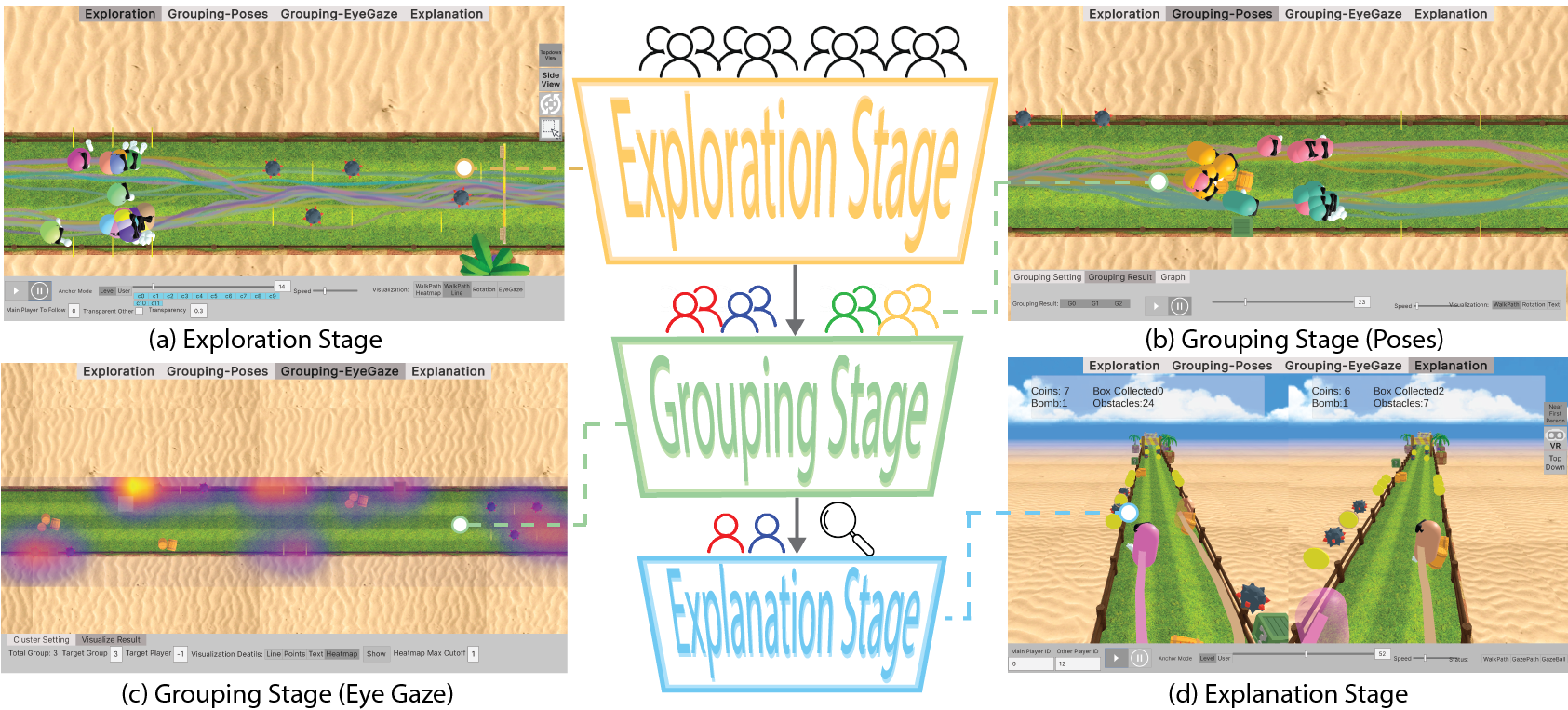
Playtesting is widely used in the game industry to identify design flaws and evaluate player experience, yet little research explores how to effectively visualize and analyze playtesting data. This challenge is particularly pronounced in motion-based VR games, which involve physical movements and interactions tracked through multimodal inputs, resulting in complex multidimensional data. To better understand the challenges designers face, we conducted a formative study with 30 practitioners in the VR domain to characterize playtesting workflows and associated tasks. Based on these findings, we present HieraVisVR, a hierarchical visual analytics framework that incorporates body-motion-related data to help designers identify player behaviors and critical game moments, simplifying their workflow. We demonstrate the applicability of HieraVisVR in three different applications and evaluate our system with playtesting experts through an analysis of motion-based game data. The study results suggest that our system enhances playtesters’ understanding of the gameplay and improves their data analysis workflow.
Type
Publication
In Proceedings of the ACM Conference on Human Factors in Computing Systems (CHI'26)
Abstract
Playtesting is widely used in the game industry to identify design flaws and evaluate player experience, yet little research explores how to effectively visualize and analyze playtesting data. This challenge is particularly pronounced in motion-based VR games, which involve physical movements and interactions tracked through multimodal inputs, resulting in complex multidimensional data. To better understand the challenges designers face, we conducted a formative study with 30 practitioners in the VR domain to characterize playtesting workflows and associated tasks. Based on these findings, we present HieraVisVR, a hierarchical visual analytics framework that incorporates body-motion-related data to help designers identify player behaviors and critical game moments, simplifying their workflow. We demonstrate the applicability of HieraVisVR in three different applications and evaluate our system with playtesting experts through an analysis of motion-based game data. The study results suggest that our system enhances playtesters' understanding of the gameplay and improves their data analysis workflow.
Publication
In Proceedings of the ACM Conference on Human Factors in Computing Systems (CHI'26)
Video

Authors
Yongqi Zhang
(she/her)
HCI + AI Research Scientist
She is an HCI and AI Researcher who recently earned a PhD in Computer Science from George Mason University. As a member of the Design Computing and eXtended Reality (DCXR) group under the advisement of Prof. Craig Yu, their research focused on the intersection of virtual reality (VR), computational design, and human-computer interaction. [Your Name] specializes in leveraging AI and computational techniques to develop personalized virtual experiences and automated scene generation. She is currently seeking new professional opportunities in research and development.