Mixed-Integer Programming for Adaptive VR Workflow Training
October 28, 2023· ,,,,·
2 min read
,,,,·
2 min read
Yongqi Zhang
Chuan Yan
Haikun Huang
Simon Su
Lap-Fai Yu
Abstract
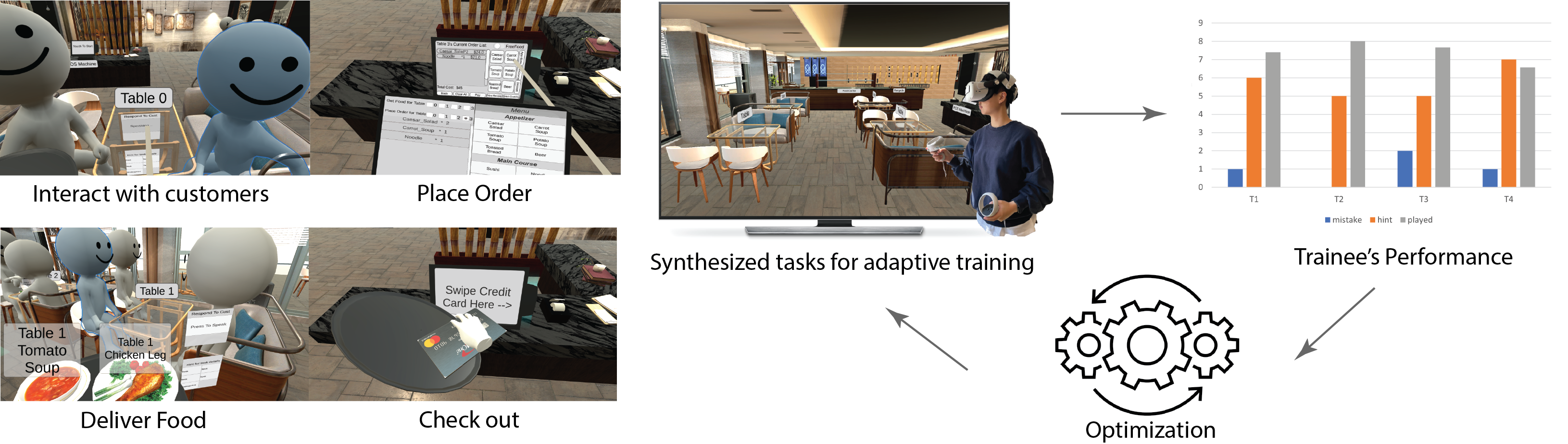
With advances in consumer-grade virtual reality (VR) devices, VR training gains unprecedented attention in research and industries. Although the nature of VR training encourages trainees to actively learn through exploring and gathering information in a simulated virtual environment, designing effective virtual training environments is non-trivial. We propose an adaptive approach that guides trainees to develop psychomotor skills in a simulated virtual environment. As a showcase, we demonstrate our novel approach for restaurant service using a game-based VR application. By incorporating the trainee’s performance and learning progress into optimization objectives, our approach uses mixed integer programming (MIP) to generate VR training sessions iteratively. Through collecting the trainee’s performance in VR training, our approach adapts the VR training sessions by considering the trainee’s strengths and weaknesses, guiding the trainee to improve over training sessions. We validated our approach through two experimental studies. In the first study, we compared our approach with a random training task assignment approach and a performance-only MIP approach through performing simulated restaurant service training. In the second study, we compared our approach with the random assignment approach by evaluating trainees’ skill developments in restaurant services. The results show that our skill-driven adaptive training approach outperforms the random assignment approach.
Publication
In Proceedings of the 26th HCI International Conference, HCII 2024
Video

Authors
Yongqi Zhang
(she/her)
HCI + AI Research Scientist
She is an HCI and AI Researcher who recently earned a PhD in Computer Science from George Mason University. As a member of the Design Computing and eXtended Reality (DCXR) group under the advisement of Prof. Craig Yu, their research focused on the intersection of virtual reality (VR), computational design, and human-computer interaction. [Your Name] specializes in leveraging AI and computational techniques to develop personalized virtual experiences and automated scene generation. She is currently seeking new professional opportunities in research and development.