Joint Computational Design of Workspaces and Workplans
February 28, 2021· ,,,,·
1 min read
,,,,·
1 min read
Yongqi Zhang
Haikun Huang
Erion Plaku
Christos Mousas
Lap-Fai Yu
Abstract
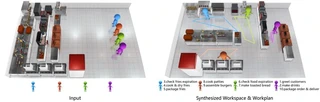
Humans assume different production roles in a workspace. On one hand, humans design workplans to complete tasks as efficiently as possible in order to improve productivity. On the other hand, a nice workspace is essential to facilitate teamwork. In this way, workspace design and workplan design complement each other. Inspired by such observations, we propose an automatic approach to jointly design a workspace and a workplan. Taking staff properties, a space, and work equipment as input, our approach jointly optimizes a workspace and a workplan, considering performance factors such as time efficiency and congestion avoidance, as well as workload factors such as walk effort, turn effort, and workload balances. To enable exploration of design trade-offs, our approach generates a set of Pareto-optimal design solutions with strengths on different objectives, which can be adopted for different work scenarios. We apply our approach to synthesize workspaces and workplans for different workplaces such as a fast food kitchen and a supermarket. We also extend our approach to incorporate other common work considerations such as dynamic work demands and accommodating staff members with different physical capabilities. Evaluation experiments with simulations validate the efficacy of our approach for synthesizing effective workspaces and workplans.
Type
Publication
In ACM Transactions on Graphics (SIGGRAPH Asia 21)
Overview
Fastfood Restaurant: Solution 1
Fastfood Restaurant: Solution 2
Fastfood Restaurant: Solution 3
Accessibility: Donation Center
Supermarket: Morning Strategy
Supermarket: Afternoon Strategy

Authors
Yongqi Zhang
(she/her)
HCI + AI Research Scientist
She is an HCI and AI Researcher who recently earned a PhD in Computer Science from George Mason University. As a member of the Design Computing and eXtended Reality (DCXR) group under the advisement of Prof. Craig Yu, their research focused on the intersection of virtual reality (VR), computational design, and human-computer interaction. She specializes in leveraging AI and computational techniques to develop personalized virtual experiences and automated scene generation. She is currently seeking new professional opportunities in research and development.